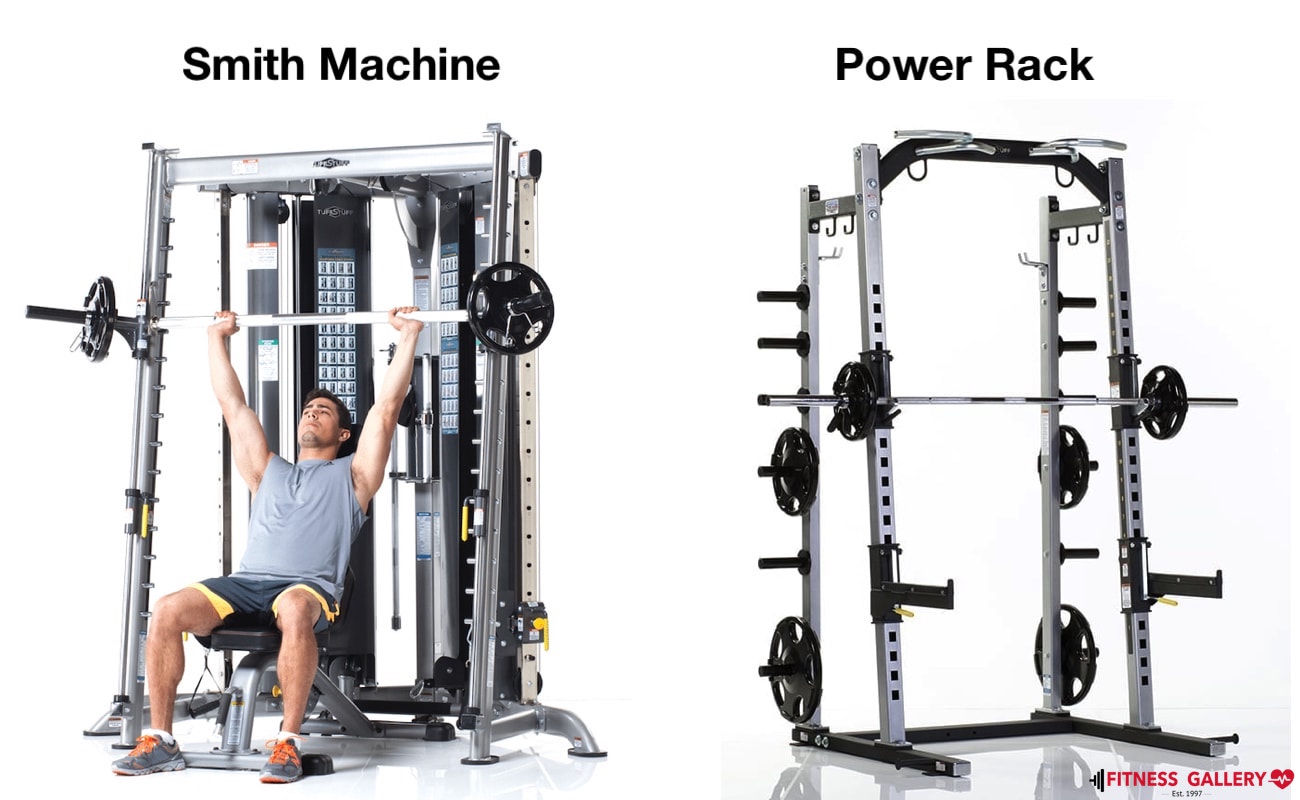
For most who go to the gym, the barbell is the holy grain of their program. The barbell can be used in the three primary lifts; deadlifts, bench, squat, or it can even be used in abstract compound movements. Similarly to the barbell is the Smith Machine. The cousin to the squat rack. The Smith Machine is a barbell that glides along a rail for isolated movements.
What are the differences between these two? Is one better than the other?
The Smith Machine
The Smith Machine is the cousin to the squat rack and barbell. The Smith Machine difference is the fact that it is an attached rail type system. The rail system only allows the barbell to travel up and down along the rails. Substantially it limits the mobility of the exercise to only go up or down. Because of the limited movement of the training, it decreases the chance of any injuries.
Pros
The Smith machine is greatly used for isolating particular muscles in the workout. For example, if someone wants to specifically target the upper part of the upper chest, the Smith Machine can do just that. Because the track only allows up and down movements, it focuses the muscles explicitly used for the lift rather than the isolation muscles.
The Smith Machine is also great for beginners to learn new movement. Because the machine only allows up and down movements, it is easier to learn how to do a particular exercise and get used to the movement. On top of that, it is also safer and less likely to lead to injury.
Cons
Where the Smith Machine leads in safety, it lacks in stabilization muscles. These muscles used in free weights help your overall strength, where the Smith Machine doesn’t. Another con of the Smith Machine is the pulley-system used. In most modern Smith Machines, there is a pulley-system that reduces the weight of the bar. The weight of the barbell on the smith machine is 15lbs, whereas the barbell is a deadweight of 45.
The Barbell:
The barbell is a free weight that engages the stabilization muscles. The barbells makes you balance and support the weight, which leads to muscle growth. It is a 3-dimensional training environment; up, down, and sideways.
Pros
The free weight function of the barbell, as mention, sparks dynamic muscle growth. More muscles are involved, and more elements are involved in a free weight, because of the open range of movement, the
Cons
The free weight aspect is much riskier in terms of injury. Because many different factors are in play with free weights, the form is the most crucial part. With proper form, injury can be avoided.
 Dano's College Fitness Blog